
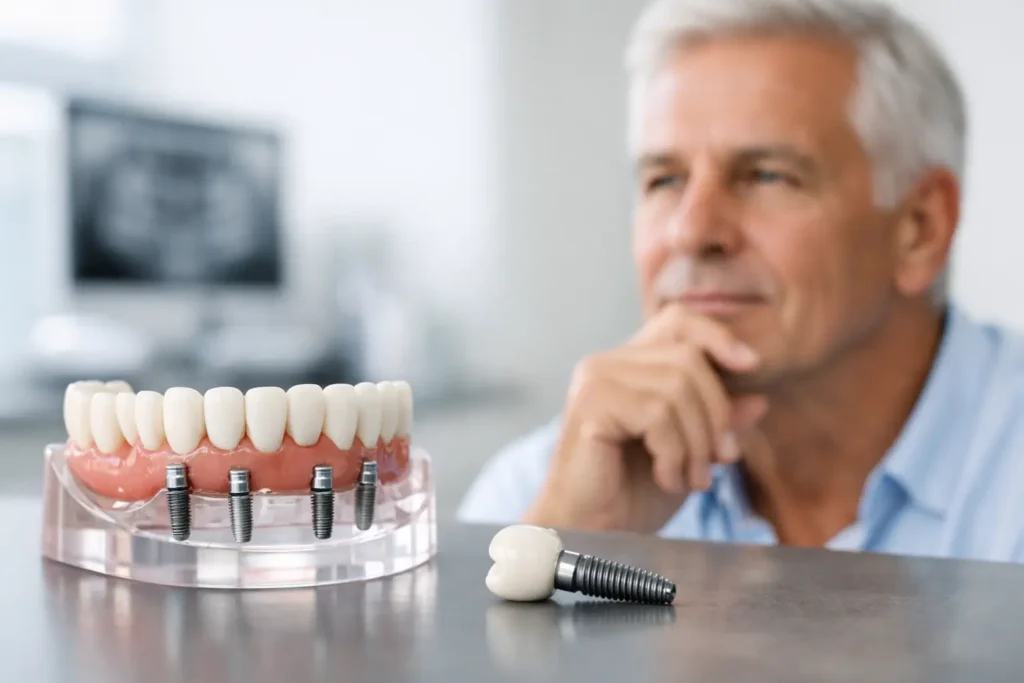
A denture that shifts while you eat or makes you think twice before smiling can affect far more than your appearance. For people missing most or all teeth, all on four dental implants can provide a stable, full-arch replacement designed to look natural, feel secure, and support everyday confidence.
This treatment is not simply about placing four implants and leaving with a new smile. It is a carefully planned restorative process that considers bone health, gum condition, bite alignment, facial support, and the long-term care of your new teeth. Knowing what it involves can help you make a confident decision.
What Are All on Four Dental Implants?
All on four dental implants are a full-mouth tooth replacement option that uses four strategically positioned dental implants to support a complete upper or lower arch of teeth. Rather than replacing each missing tooth with its own implant, the implants serve as secure anchors for a custom bridge.
The two implants toward the front of the jaw are typically placed vertically. The back implants may be angled to take advantage of available bone and create a stable foundation for the restoration. This approach can allow some patients to avoid more extensive bone-grafting procedures, although that is never guaranteed. A detailed examination and 3D imaging are needed to determine what is appropriate for your mouth.
The bridge is fixed in place, meaning it does not come out at night like a traditional denture. Your dentist can remove it when professional maintenance is needed, but day-to-day it is designed to function much like natural teeth.
Who May Be a Good Candidate?
This option can be especially helpful for adults who have lost most of their teeth, wear loose or uncomfortable dentures, or have teeth that are severely damaged and cannot be predictably restored. It may also be considered when advanced decay or gum disease has made a full-arch restoration the healthiest path forward.
However, candidacy depends on more than the number of missing teeth. Your dental team needs to assess the quality and volume of jawbone, the health of your gums, your bite, and your overall medical history. Conditions such as uncontrolled diabetes can affect healing. Smoking and vaping can also increase the risk of implant complications. People who clench or grind their teeth may still be candidates, but they may need a protective night guard and a restoration designed to handle additional force.
Active gum disease must be treated before implant placement. Implants cannot compensate for an untreated infection or poor oral hygiene. A successful result starts with a healthy foundation and a patient who is prepared to maintain it.
The All on Four Dental Implant Process
Every treatment plan is different, but the process usually begins with a comprehensive consultation. Your dentist will review your goals, take digital images or a 3D scan, examine your bite, and discuss whether existing teeth need to be removed. This is also the time to talk openly about comfort options, timing, medical considerations, and the look you want for your final smile.
Planning the foundation
Implant placement is not a one-size-fits-all procedure. The location, angle, and size of each implant are selected to create the best possible support for the final bridge. A coordinated team that includes implant, surgical, periodontal, and restorative expertise can be valuable because each part of treatment affects the next.
If extractions are needed, they may be completed during the implant procedure. In many cases, a temporary full-arch restoration can be attached soon after surgery. This gives patients teeth during the healing period and can help maintain appearance and function.
Temporary teeth are not the final bridge
Same-day temporary teeth can be a major benefit, but they are not the finished restoration. During the first months after implant surgery, the implants need time to integrate with the jawbone. Your temporary teeth are generally designed for a softer diet and careful use while healing takes place.
Once your dental team confirms that the implants are stable, measurements are taken for the final bridge. The final restoration is custom-made to support your bite, speech, facial proportions, and smile preferences. A dedicated dental laboratory can make a meaningful difference here, since the final result depends on precise fit as well as natural-looking shape and color.
Benefits Worth Considering
The most immediate advantage is stability. A fixed implant-supported bridge does not rely on adhesives or rest on the gums the way a traditional denture does. Many patients find that eating, speaking, and laughing feel more comfortable once they no longer have to worry about a denture slipping.
All on four treatment may also reduce the number of implants required for a full arch compared with placing an implant for every missing tooth. For qualifying patients, the strategic implant angles can make use of available bone in areas where it is strongest.
There is an aesthetic benefit as well. Missing teeth and worn dentures can change facial support over time. A well-designed full-arch restoration can restore tooth display, improve smile balance, and provide support for the lips and cheeks. The goal is not an overly uniform or artificial look. It is a smile that fits your face and feels like your own.
Important Trade-Offs to Understand
Dental implants are a significant investment in health and function, and they require surgery, healing time, and ongoing care. While the treatment can be highly successful, no implant procedure is risk-free. Infection, incomplete bone integration, bite-related stress, and mechanical repairs are all possibilities that should be discussed before treatment begins.
All on four dental implants are also not the only solution for full-mouth tooth loss. Some patients may benefit from implant-supported removable dentures, additional implants, individual implants, or treatment to preserve remaining natural teeth. When teeth can be predictably saved, keeping them may be the better long-term choice.
Cost should be discussed as a complete treatment plan rather than a single number. Ask what is included in the estimate, such as imaging, extractions, temporary teeth, implant surgery, the final bridge, sedation if needed, and follow-up visits. If you are traveling from Arizona, Southern California, Nevada, or elsewhere for care in San Luis Río Colorado, ask how appointments and follow-up planning will be coordinated around your travel schedule.
Caring for Your New Smile
A fixed bridge cannot decay, but the tissues around the implants can still become inflamed or infected without proper hygiene. Daily care generally includes brushing the bridge and gums, cleaning beneath the restoration with tools recommended by your dental team, and attending regular professional maintenance visits.
Your dentist may recommend a water flosser, implant-specific floss, interdental brushes, or other cleaning aids based on the design of your bridge. Regular visits allow the team to monitor gum health, bite pressure, the condition of the bridge, and the implants beneath it. Small adjustments made early can help protect your investment.
It is also wise to avoid using your teeth as tools, chewing ice, or biting hard objects. If you grind your teeth, wearing the recommended night guard can protect both the bridge and the implant system.
Questions to Ask at Your Consultation
A meaningful consultation should leave you clear on the plan, not pressured into a decision. Ask whether all of your remaining teeth need to be removed or if any can be saved. Ask what type of temporary restoration you will receive, how long healing is expected to take, and what material is planned for the final bridge.
You should also ask who will perform each stage of care, how complications are handled, and what maintenance will be needed over time. If you have medical conditions, take blood-thinning medication, smoke, or have a history of gum disease, bring those details up early so your plan can be tailored appropriately.
A full-arch restoration can be life-changing when it is built on careful diagnosis, skilled treatment, and a commitment to long-term care. The right next step is a personalized evaluation that puts your health, comfort, and confidence at the center of the conversation.
